
After seven years at Dairy Australia, I have been reflecting on the choices facing Australia’s rural research and development corporations, or RDCs. I began by working on a five-year strategic plan and later led research strategy and investment. Across both roles, the same question kept returning: where can collective investment make the greatest difference?
The RDC model took its current shape through reforms in 1989, building on earlier industry research levies. It allows producers to pool money for research that few could fund alone, with government contributing to eligible research within statutory limits. The system has since evolved to include government-established bodies and industry-owned companies. Today there are 15 RDCs serving agriculture, fisheries and forestry. Their work includes research and helping producers put its findings into practice. 1, 2
I believe the model remains worth investing in. But it asks RDCs to meet competing expectations. Producers need practical benefits from their levies, and government needs value for public money. Both can be difficult to demonstrate when research takes years to deliver and immediate problems need attention.
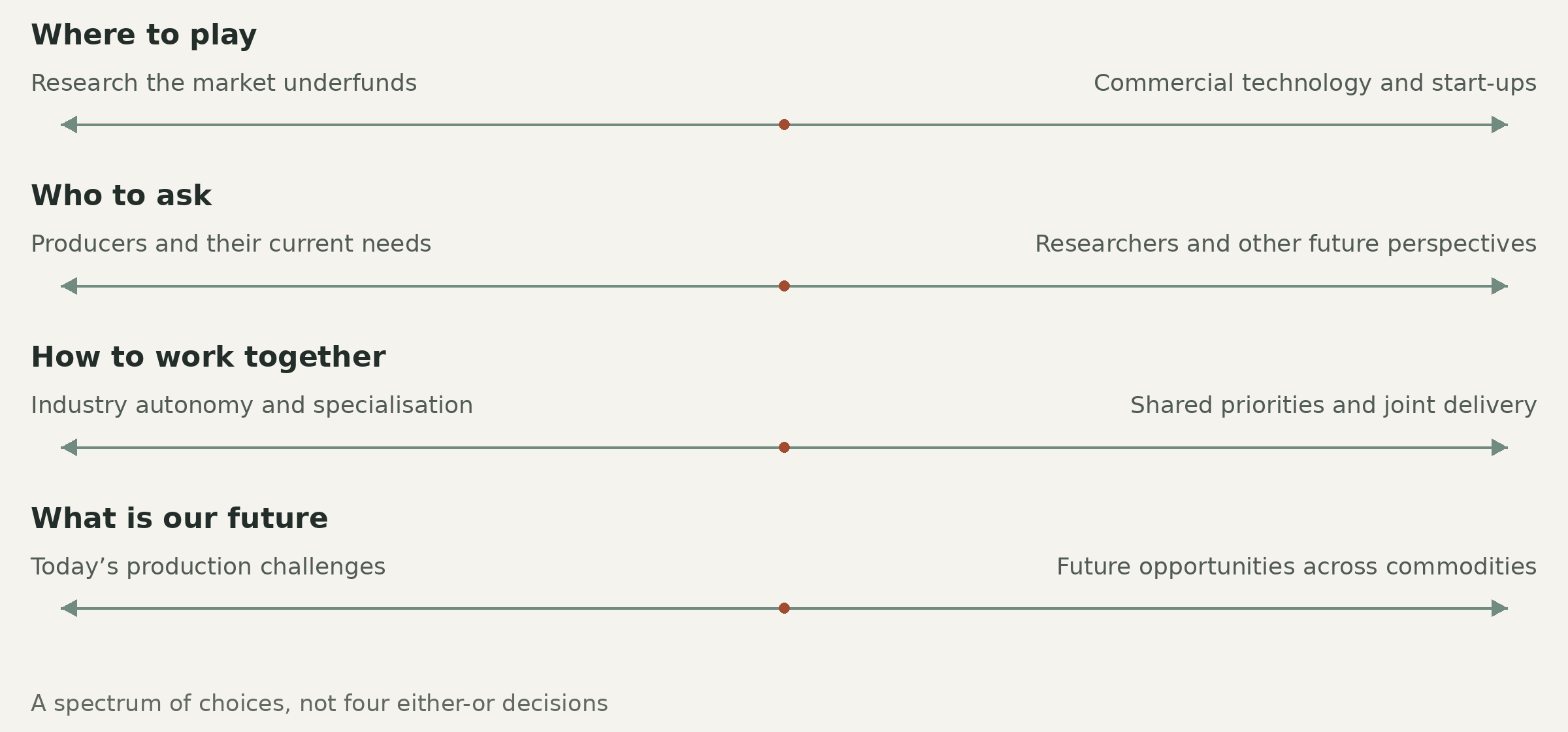
Four questions capture the push and pull forces I encountered: where should RDCs play, whose views should shape investment, how should they work together, and what future should they invest towards? There is no single right balance. But the choices should be deliberate and open to scrutiny.
The push and pull forces
A spectrum of choices, not four either-or decisions.
Where to play
Who to ask
How to work together
What is our future
Where to play
One challenge in research investment is deciding when an RDC should get involved and what role it should take. Long-term science and commercial technology both have a place, but they call for different investment decisions.
Economists use the term “market failure” to describe situations where markets do not produce enough of something valuable. In agricultural research, a producer or company may be unable to capture enough of the benefits to justify paying for the work. For example, research that helps an entire industry manage a disease could benefit many businesses beyond the original funder. Collective investment can help close that gap. 2
The question becomes harder when the opportunity is a product that a business could sell. A start-up may already have a reason to develop it. An RDC’s contribution then needs to be clear: would the investment enable something that would otherwise not happen, happen too slowly, or reach too few producers?
I would make that assessment explicit. Before committing funds, ask what problem is being addressed, what would happen without the RDC, and why it is best placed to act. Then choose the role. Funding research, independently testing a product, bringing partners together and delivering a service are different responsibilities.
Consider a farm technology that could reduce labour requirements. An RDC might fund independent trials and share evidence about its benefits and limitations, while a commercial provider supplies and supports it. The appropriate arrangement will depend on the technology and the market around it. The investment should also identify who will help producers use the result and when the RDC should review or end its involvement.
This is what “right to play” means to me: a clear reason to act, a useful contribution and the capability to deliver it. The same test should apply to a university proposal and a commercial partnership.
Who to ask
My earlier experience at Telstra gave me a useful point of comparison. A listed company has shareholders, customers and a board responsible for its direction. RDCs bring a different relationship: producers are often both funders and intended beneficiaries, while government contributes public money and sets expectations. Those overlapping relationships make accountability more complicated.
Listening to producers is essential. They understand the practical constraints that can determine whether an innovation succeeds. They also run different businesses, so consultation will rarely produce one agreed set of priorities. Researchers and other specialists can contribute evidence about emerging possibilities and risks. Those perspectives should be considered alongside producer knowledge.
The difficult task is deciding how to allocate money when needs compete. A pressing production issue may warrant a quick response. Research with a ten-year horizon may deserve investment even when its benefits are harder to explain today. Neither timescale tells us, on its own, how risky or valuable the work will be.
I would separate consultation from the final investment decision. The value of consultation is in understanding needs and testing assumptions, including where interests conflict. Boards and executives then need to explain the choices they make, including what will receive less funding. A portfolio, meaning the organisation’s overall mix of investments, should show how immediate improvements and longer-term opportunities fit together.
The Commonwealth has a role here too. Government expectations already exist in funding agreements and innovation policy. 1, 3 My question is whether those expectations translate clearly enough into practical choices between competing investments. A shared view of intended outcomes would make it easier to explain why some valuable work must begin before demand for it becomes widespread.
How to work together
Working across industries was one of the hardest challenges I encountered. That was not for lack of effort or goodwill. Each organisation has its own plans, approval processes and accountability to its levy payers. Those arrangements can make a shared problem difficult to fund and deliver together.
There is a reason for industry specialisation. Dairy, grains and fisheries face different production systems and business conditions. But workforce capability, data standards and some biosecurity challenges extend across those boundaries. We should ask which parts of a problem require industry expertise and which would benefit from a common response.
The 2019 discussion about modernising the RDC system raised questions about collective effort. Subsequent initiatives have sought to strengthen coordination, and the RDCs’ own reporting describes existing collaboration. 3, 4 The task is to make joint work easier to sustain and accountable for results.
For a shared priority, I would start with an agreed outcome, a lead organisation, a jointly committed budget and a clear way to make decisions. Success should be assessed by what changes for producers, rather than how many organisations participate. Jointly developed tools should have an owner and a plan for ongoing support.
Shared procurement, evaluation methods or selected administrative services may also be worth testing where the benefits outweigh the transition costs. But administrative savings and joint innovation are different objectives. Combining support functions will not, by itself, settle who funds a cross-industry problem or who is responsible for delivering the result.
What is our future
Should investment begin with today’s production challenges or with a view of what competitive Australian agriculture could become? Both matter, but they lead to different choices.
ABARES has documented slower productivity growth in broadacre farming since 2000 than in the preceding decades. Productivity here means how much farms produce relative to the inputs they use. The pattern varies across industries, and weather and structural change also influence performance. It would be too simple to attribute the slowdown to RDCs. It does, however, strengthen the case for examining how research investment can contribute to future gains. 5
I would like to see a clearer distinction between investments that improve today’s businesses and those that create options for tomorrow. The latter could include technologies that change labour requirements, ways to use data across farming systems, or production approaches that remain profitable under different climate conditions.
One option worth testing is a jointly funded program for a small number of long-term challenges that cross industry boundaries, with a clear remit that respects funding rules and the work already being done elsewhere. Each challenge would need an accountable leader, milestones and a credible route to practical use. RDCs could retain their industry expertise and producer relationships while contributing to work that none could justify funding alone.
Before debating mergers, I would ask whether our funding and decision-making arrangements make enough room for work that benefits agriculture collectively, alongside the industries that fund each RDC.
After seven years in the system, I see these questions as central to the next stage of its development. Each RDC should be able to explain why it is acting, how priorities were chosen, where working together adds value and what future its investments are helping to create. Those explanations would give producers and taxpayers a clearer basis for judging the choices made on their behalf.
Sources and further reading
- Research and development corporationsDepartment of Agriculture, Fisheries and Forestry
- A Retrospective on Rural R&D in Australia (2009)Peter Core with the Department of Agriculture, Fisheries and Forestry
- National Agricultural Innovation AgendaDepartment of Agriculture, Fisheries and Forestry
- Collective Research and Innovation Outcomes Report 2025Council of Rural Research and Development Corporations
- Australia’s farm productivity slowdown (2024)ABARES